What Are the Top Types of Hydraulic Cutting Machines?

Choosing the right Hydraulic Cutting Machine starts with understanding what it cuts and how the material is held. A machine built for sheet metal may not suit leather, rubber, or stacked fabric. The name alone can be misleading. Different designs use hydraulic force in different ways, from shearing a straight edge to pressing a shaped die through material.

This guide introduces the main types, including hydraulic guillotine shears, hydraulic press cutters, and hydraulic punching machines. A guillotine shear uses a moving blade to trim sheet metal; operators may notice the clean, straight cut and the need to set blade clearance correctly. A press cutter pushes a die into sheet or layered material, making it useful for repeat shapes. Punching machines create holes or slots with matched tooling. Some equipment combines operations, but that does not automatically make it the best choice.

The right option depends on material thickness, cut shape, production volume, and available tooling. Look beyond maximum force: check working width, stroke, adjustment range, and how easily operators can load and position material. Small details matter. A machine that performs well on a sample may behave differently during a full shift, especially when material varies. There is no universal winner, and a specification sheet cannot reveal every setup limitation. Comparing machine types against real production needs offers a more dependable starting point.
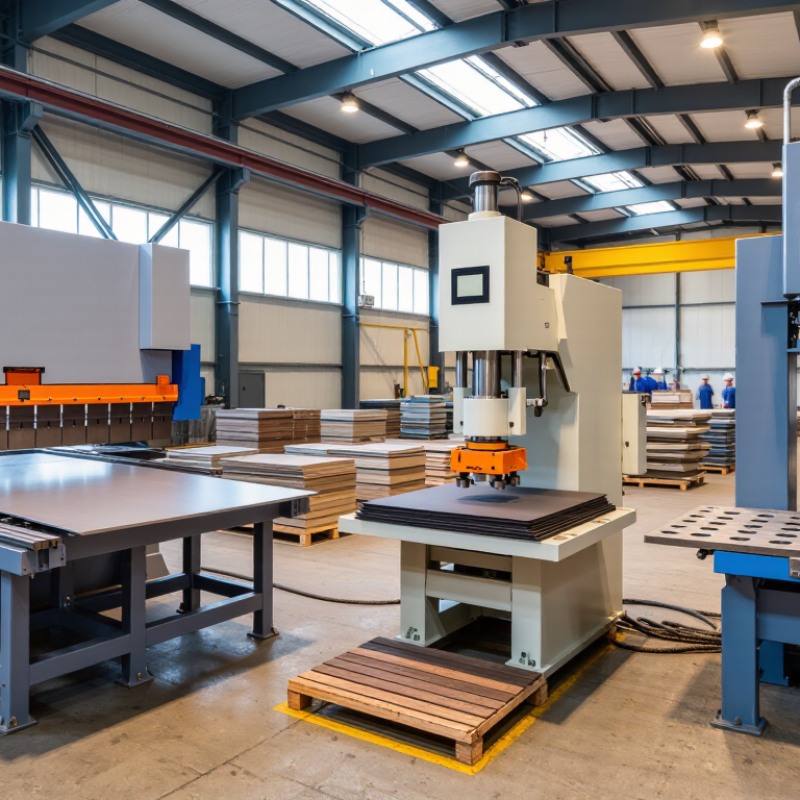
What Are the Top Types of Hydraulic Cutting Machines?

Hydraulic Cutting Machine Classes: Common Systems Operate Near 210 bar (3,000 psi)

What Are the Top Types of Hydraulic Cutting Machines?

Hydraulic cutting machines include guillotine shears, press cutters, and punch-style systems. Each uses hydraulic pressure to drive a blade or die through material. Many common systems operate near 210 bar (3,000 psi), but this is a reference point, not a universal setting. Required pressure depends on cylinder size, blade geometry, material thickness, and machine design. Pressure alone does not show how much cutting force a machine can deliver.

Guillotine shears make long, straight cuts in sheet material. Press cutters use shaped dies for repeatable outlines, while punch-style machines create holes or profiles. Near 210 bar, a system may have enough pressure for its intended task, yet poor blade clearance can still leave rough edges. Check the machine’s rated specifications and observe its performance under load. A gauge reading at rest may not reflect pressure during the cutting stroke.

Tips: Match the machine to the material and cut shape. Check pressure during operation, inspect blade clearance, and keep hands away from the cutting area. One detail is easy to overlook: worn blades can affect cut quality even when pressure looks normal.

Hydraulic Guillotine Shears: Blade Clearance and Sheet-Metal Capacity

Hydraulic guillotine shears are often judged by maximum thickness, but blade clearance can make or break the cut. ASM Handbook, Volume 14B, explains that clearance depends on stock thickness and material properties. A common starting range for low-carbon steel is 5–10% of thickness per side. For 6 mm sheet, that means roughly 0.3–0.6 mm per side. Small gap. Big effect.

Too little clearance can raise cutting force and accelerate blade wear. Too much may leave a rough edge and a heavy burr. Check the cut face, not just the machine scale. Machinery’s Handbook also relates shearing force to material strength, thickness, and cut length; a longer cut or stronger alloy needs more force. So a machine rated for 6 mm mild steel may not handle 6 mm stainless steel across the same blade length. That sounds obvious, yet it is easy to overlook when comparing capacity labels.

For a practical setup, confirm the material grade, thickness, and full cutting length before selecting a shear. Then make a short test cut and inspect both edges. A clean face with a small, even burr is a useful sign. These ranges are starting points, not guarantees; blade condition and setup still matter.

What Are the Top Types of Hydraulic Cutting Machines? — Hydraulic Guillotine Shears: Blade Clearance and Sheet-Metal Capacity
Representative Shear Class Typical Mild-Steel Capacity Common Cutting Length Typical Blade-Clearance Guidance Example Clearance at Top Rated Thickness
Light-duty About 1–3 mm About 1–3 m Often set near 5–10% of sheet thickness for mild steel. At 3 mm: approximately 0.15–0.30 mm
Medium-duty About 4–8 mm About 2–4 m Often set near 5–10% of sheet thickness for mild steel. At 6 mm: approximately 0.30–0.60 mm
Heavy-duty About 10–16 mm About 3–6 m Set the blade gap to suit the material, thickness, and shear design. At 12 mm: approximately 0.60–1.20 mm
Very heavy-duty About 20–25 mm About 4–8 m Use the machine maker’s clearance chart; settings are especially important at higher thicknesses. At 20 mm: approximately 1.00–2.00 mm
These are indicative industry ranges, not universal machine ratings. Capacity depends on the shear’s design, cutting length, blade condition, and the material’s strength. The example gaps apply the 5–10% guideline to mild steel; confirm whether a machine specifies clearance as the total blade gap or by another convention. Stainless steel and other higher-strength materials may require reduced capacity and material-specific clearance settings. Always follow the machine’s operating manual and clearance chart.

Hydraulic Press and Die Cutters: Force Ratings Use kN; 1 tf = 9.81 kN

Hydraulic cutting machines include swing-arm clicker presses, traveling-head cutters, and flatbed die presses. Each applies force differently across the cutting area. A swing-arm model suits smaller dies and flexible work; a traveling head moves over larger sheets. Flatbed presses hold material and tooling between platens. Their force ratings are commonly stated in kilonewtons (kN), not simply by the size of the machine.

For comparison, 1 tf equals 9.81 kN, so a 10 tf press is rated at about 98.1 kN. That number describes force, not hydraulic pressure. Pressure depends on factors such as cylinder area, and the available force may vary with machine design and operating conditions. Check the rated cutting force, stroke, and usable bed area against the die and material. A thick stack of leather may need a different setup from thin gasket sheet. Ratings alone do not tell the whole story.

Tips: Convert tf to kN by multiplying by 9.81. Confirm whether a quoted figure is maximum or continuous force, and ask how it applies across the cutting bed. Leave a margin for material variation and dulling blades. I would double-check the actual specification sheet; unit labels are easy to misread, and that small mistake can lead to poor cuts.

Hydraulic Cutting Machines: Force Ratings in kN

Hydraulic clicker presses, traveling-head presses, swing-arm presses, and beam presses are commonly used for die cutting. Their rated force is expressed in kilonewtons (kN) or tonne-force (tf). The chart converts tf ratings to kN using 1 tf ≈ 9.81 kN.

These values are unit conversions, not ratings for specific machines. When comparing cutters, check the manufacturer’s stated maximum force and ensure the machine suits the material, die, and cutting area.

Portable Hydraulic Hose Cutters: Match Capacity to Hose Size and Reinforcement

What Are the Top Types of Hydraulic Cutting Machines?

Portable Hydraulic Hose Cutters: Match Capacity to Hose Size and Reinforcement

Portable hydraulic hose cutters are useful when hoses need clean, repeatable cuts away from a workshop. Choose capacity by checking the hose’s outside diameter and construction, not just its nominal size. A compact cutter may handle textile-reinforced hose but struggle with multiple steel-wire layers. That matters. A blade that is undersized can crush the hose or leave uneven wire ends.

Before buying or using a cutter, compare its rated capacity with the hose manufacturer’s specifications. Check whether the rating covers braided wire, spiral reinforcement, or both. Also consider the tool’s weight, power source, and blade replacement process. If you work beside a service vehicle, a lighter unit may be easier to position. But portability alone is not enough.

Hydraulic-Intensifier Waterjets: Cutting Pressures Reach 6,200 bar (90,000 psi)

Hydraulic-intensifier waterjets use hydraulic power to raise water pressure through a piston-and-plunger system. Some systems reach about 6,200 bar, or 90,000 psi, though actual cutting pressure varies by machine and setup. That pressure drives water through a tiny orifice, forming a concentrated stream. In practice, the cut depends on more than pressure alone.

For soft materials, such as foam or rubber, water alone may be sufficient. Harder materials often require abrasive particles mixed into the stream. A narrow kerf can help cut intricate shapes, while the absence of heat reduces thermal distortion.

The trade-off is real. Orifices and mixing tubes wear over time, and abrasive flow, water quality, and feed speed all affect consistency. Operators need to monitor these details rather than assume maximum pressure guarantees a clean edge.

Thick workpieces may show taper, especially when settings are poorly matched. High-pressure leaks are also difficult to see and can cause severe injury, so guarding and trained operation matter.

The pressure rating sounds impressive, but it is only one part of a reliable cut.