
How to Choose Backup Power for a Sump Pump in 2026?
Choosing back up power for sump pump protection in 2026 requires more than buying the largest battery available. A basement can flood within hours when a storm interrupts electricity. NOAA’s National Centers for Environmental Information recorded 27 U.S. billion-dollar weather and climate disasters in 2024, costing approximately $182.7 billion. FEMA’s National Risk Index also identifies flooding as a major hazard across many communities. These reports do not predict every basement failure. They show why outage planning deserves practical attention.
A reliable system should match the pump’s horsepower, discharge height, expected runtime, and starting current. Battery capacity matters, but it is not the whole answer. A small pump may run efficiently, while a larger model can drain a battery quickly during repeated storms. Homeowners should examine battery chemistry, charger quality, transfer equipment, alarm functions, and compatibility with the existing sump basin. NFPA guidance on emergency power emphasizes proper installation, inspection, and safe equipment use. Local electrical requirements still matter.
No setup is perfect.
A generator may provide longer runtime, but fuel storage, ventilation, noise, and maintenance create additional responsibilities. A battery backup can start automatically and operate indoors, yet it may fail when its battery ages or its charger remains unplugged. That uncomfortable detail is easy to overlook. This guide compares practical backup options, estimates realistic runtime, and explains how to test them before heavy rain arrives. The goal is not the most expensive system. It is dependable protection that works when the pump is needed most.
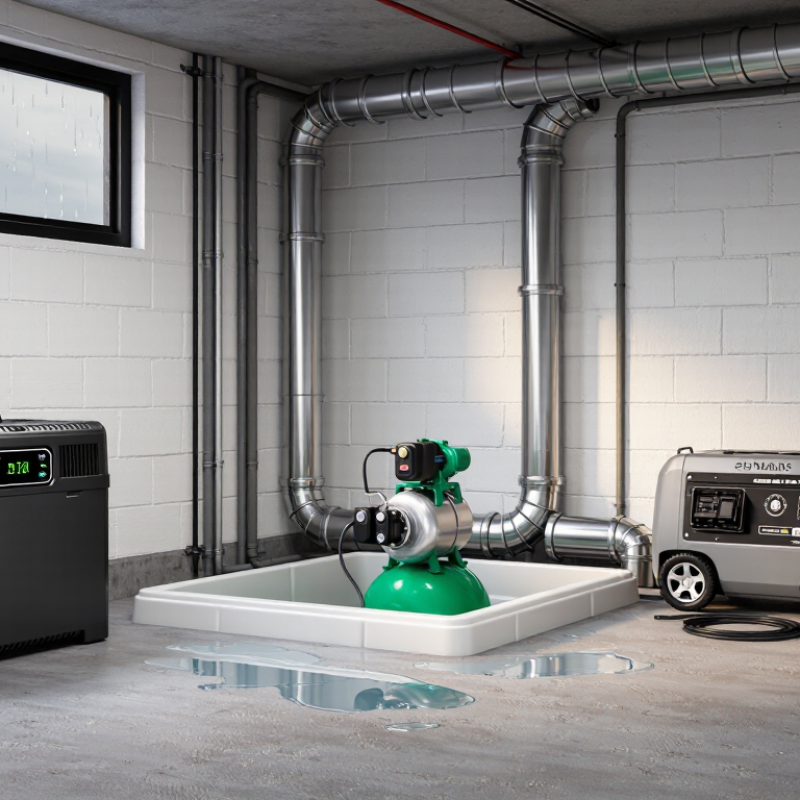
Assess Your Sump Pump’s Backup Power Requirements
How to Choose Backup Power for a Sump Pump in 2026?
Assess your sump pump’s backup power requirements before buying equipment. Check the motor’s running watts and startup surge on its data plate. A pump may draw 600 watts while running, yet briefly need twice that amount. That starting demand can overload a small inverter. Measure it if possible. A plug-in power meter helps, but some meters miss the initial surge.
Estimate how long the pump may operate during a storm. If it runs for ten minutes every hour, record that pattern during heavy rain. Multiply average wattage by expected operating hours, then allow for inverter losses. For example, 600 watts used for two total hours requires about 1,200 watt-hours before safety reserve. Batteries also lose capacity in cold basements. Leave at least 20 percent extra capacity.
Match the backup system to the pump’s starting method and outlet requirements. A pure sine wave inverter is generally safer for motor-driven equipment. Confirm its continuous and surge ratings. Test the pump with the backup connected, not just the lights. Listen for a slow start or unusual buzzing. I have seen estimates fail because homeowners ignored a clogged intake or a weak check valve. Maintenance changes power needs. Clean the pit, inspect the float switch, and test during a controlled water rise. Keep the battery above its recommended temperature range. The “perfect” calculation may still be wrong. Storm conditions rarely follow the spreadsheet.
| Assessment Dimension | What to Check | Realistic Planning Data | Backup Power Implication |
|---|---|---|---|
| Pump type | Identify whether the backup will run an AC pump, a DC pump, or a complete secondary pumping system. | AC pumps require an inverter or generator. DC pumps normally connect directly to a battery through a suitable controller. | A DC backup system generally has fewer conversion losses; an AC system needs both continuous and surge inverter ratings. |
| Motor voltage | Read the pump nameplate or installation manual. | Many residential sump pumps use 120 V AC; some backup pumps use 12 V or 24 V DC. | The battery bank, inverter, wiring, fuse, and charger must all match the system voltage. |
| Running power | Use the rated amperage rather than estimating from horsepower alone. | A typical residential pump may draw approximately 4–8 A at 120 V while running, equivalent to about 480–960 W. | Select an inverter with continuous output above the measured running load, preferably with at least 25% headroom. |
| Starting surge | Check the locked-rotor or startup specification, or measure startup current with suitable equipment. | Induction motors can briefly draw about 2–3 times their running power during startup, although the exact value varies by motor and pump load. | The inverter or generator must support the surge without shutting down or producing an undervoltage fault. |
| Required pumping rate | Compare the pump curve with the vertical lift and pipe discharge distance. | Measure total dynamic head: vertical lift plus friction and fittings. Pump flow usually decreases as total head increases. | Do not size backup power only by horsepower; the backup pump must still remove water at the actual discharge head. |
| Pump duty cycle | Record how long the pump runs during a typical storm and during the heaviest expected inflow. | Runtime can range from a few minutes per hour to near-continuous operation during flooding or a high water table. | Battery capacity should be calculated from pump-on time, not simply from the length of the storm. |
| Target backup duration | Choose a minimum operating period based on local outage history, weather exposure, and access to the property. | Common planning targets are 8, 12, or 24 hours of standby coverage; actual pump-on time may be much shorter. | Longer outages require more battery capacity, a generator, or a hybrid system with automatic recharging. |
| Battery energy | Confirm battery voltage and rated amp-hours, then account for usable depth of discharge and conversion losses. | Nominal energy = volts × amp-hours. A 12 V, 100 Ah battery stores about 1,200 Wh nominally; usable energy is lower. | For planning, multiply nominal battery energy by the manufacturer’s permitted usable fraction and by inverter efficiency when applicable. |
| Battery chemistry | Check allowable discharge depth, charging requirements, temperature limits, and ventilation requirements. | Lead-acid batteries are commonly planned around approximately 50% usable capacity for longer service life; lithium specifications vary by manufacturer. | Use the battery manufacturer’s limits rather than assuming the full nameplate capacity is available. |
| Charger capacity | Check charging current, recharge time, circuit capacity, and whether charging can continue while the pump operates. | A larger battery may require many hours to recharge with a small charger; charger output must be compatible with battery chemistry. | Choose a charger that can restore the expected energy before the next likely outage, without exceeding battery limits. |
| Environmental conditions | Review basement temperature, moisture, ventilation, flood exposure, and installation clearance. | Cold temperatures reduce available battery capacity; wet locations require equipment rated and installed for the environment. | Keep batteries and electrical equipment above possible flood levels and follow applicable electrical and fire-safety requirements. |
| Automatic operation | Verify float-switch movement, water-level sensors, alarm functions, and automatic transfer behavior. | A backup system must start without manual intervention when utility power fails or the primary pump cannot keep up. | Test the complete system under simulated outage conditions at least before storm season and after maintenance. |
| Recommended sizing formula | Use measured or nameplate values and include system losses. | Estimated battery energy needed (Wh) = pump running watts × total pump-on hours ÷ system efficiency. | Example: 600 W × 2 pump-on hours ÷ 0.85 ≈ 1,412 Wh required before adding a safety margin. |
Related Posts
-
How to Choose Backup Power for a Sump Pump?
-

The Ultimate Guide to Choosing the Best Battery Powered Sump Pump for Home Flood Protection
-
What Are the Top Battery Backup Sump Pumps in 2026?
-
How to Choose a Battery Backup Sump Pump?
-
China Top Water Pressure Backup Sump Pump Suppliers?
-
How to Choose the Best Backup Power for Your Sump Pump to Prevent Flooding